
A Miniature Arms Maker in the People’s Republic of China

Xu Yan is a master miniature gun maker from China.
Introduction
In 2006, Shelley Xu sent an introduction letter to the Craftsmanship Museum regarding her father, Xu Yan (the family name is given first in Chinese tradition). Mr. Xu is a craftsman in Tiajin, China who makes miniature weapons. Considering that China is the birthplace of gunpowder, this seems appropriate enough. However, there is a lot of misunderstanding around modern life in China, and how a craftsman might go about pursuing their passion for building small arms in a country that doesn’t allow private gun ownership.
We felt that Xu Yan’s story was very informative and undoubtedly interesting, as much of the gun collector world seems to take place in Europe and America. Yet there are many others like Mr. Xu making beautiful miniatures all around the world.
As with many of the miniature arms makers featured by the Craftsmanship Museum, Mr. Xu began making these models because he found the history and beauty of the weapons to be intriguing. Also, not having the budget to afford beautiful model arms, Mr. Xu realized that he would need to make them himself if he wanted his own. The following information includes Shelley’s answers to several questions we posed about her father’s work, along with some background on his life and resume.
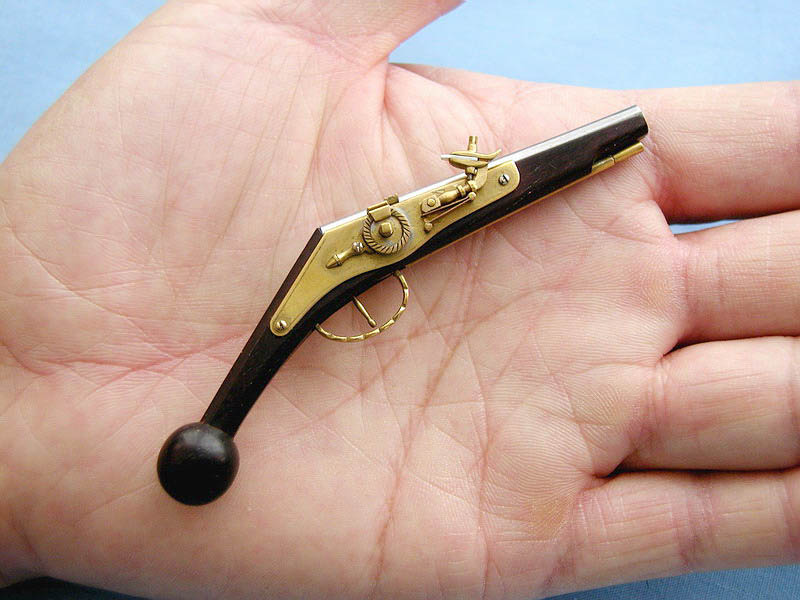
Xu Yan built this 1/6 scale 16th century British wheel lock pistol in 2002. The miniature pistol consists of 56 separate parts. This scale model firearm is so small that it fits neatly into the palm of Mr. Xu’s hand.
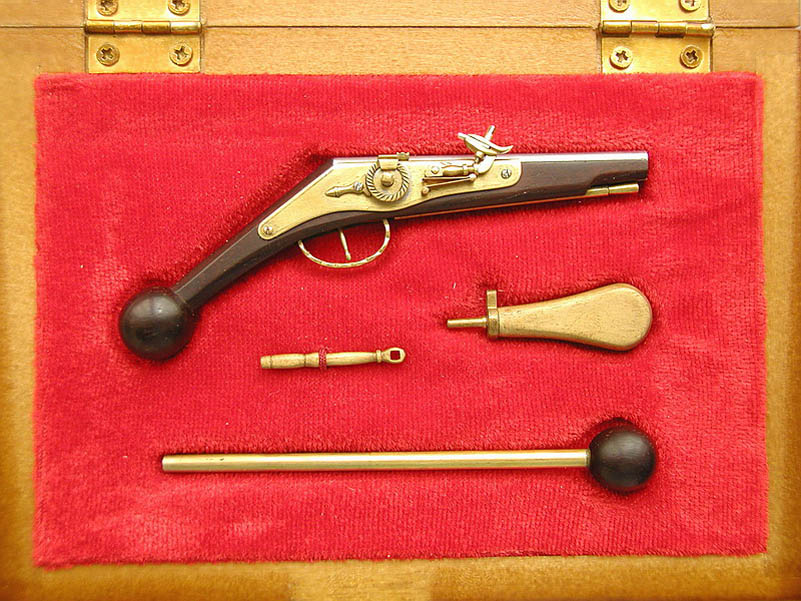
The finished wheel lock pistol is complete with a presentation case and the tools needed to load and fire the miniature weapon.
Xu Yan—An Early Interest in Arms Leads to a 40-Year Hobby
By Shelley Xu
Born on January 18, 1954 in Tianjin, Xu Yan developed an early interest in arms at around six years old. He often spent the whole afternoon watching police train not far from his home, dreaming of firing a real gun one day. With an enthusiasm for craftsmanship and a little mechanical knowledge passed on from his father, an engineer, Xu Yan started to make the first model gun of his own. It was a Mauser 98K rifle in 1/6 scale.
The material for the gun’s body was his mother’s wood ruler for cloth making, and the tools were an awl and a knife. Later, he replaced the aluminum parts with tin and strengthened the structure to withstand shooting action.
The next year, in 1964, he produced a more mature model—a Type 38 Carbine in 1/6 scale—which could perfectly complete the shooting action. This success encouraged Xu Yan to keep on making miniature guns, which has unexpectedly lasted more than 40 years.
Like most young people in China during the ’70s, Xu Yan became a factory worker after graduation from middle school. His familiarity with arms enabled him to repair guns for the military office of his chemical plant.
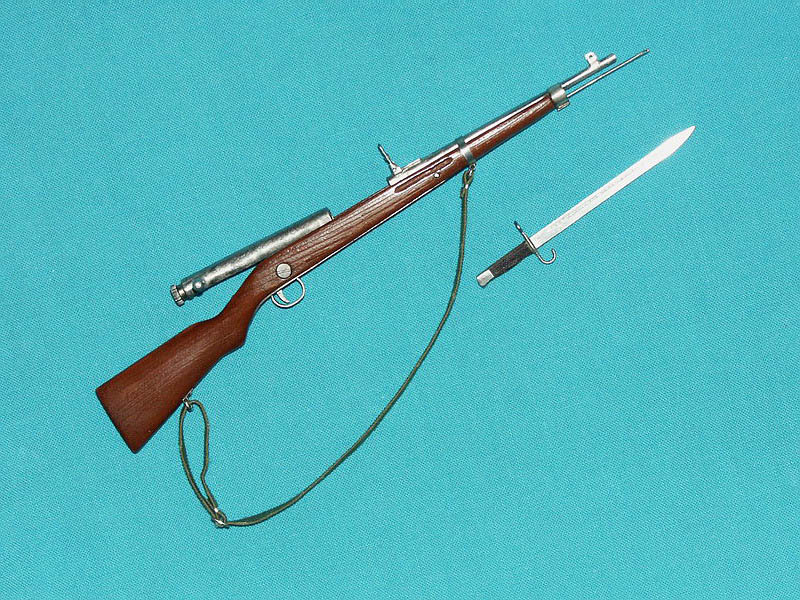
Xu Yan made this 1/6 scale Type 38 carbine in 1964. The scale rifle is complete with a detachable bayonet.
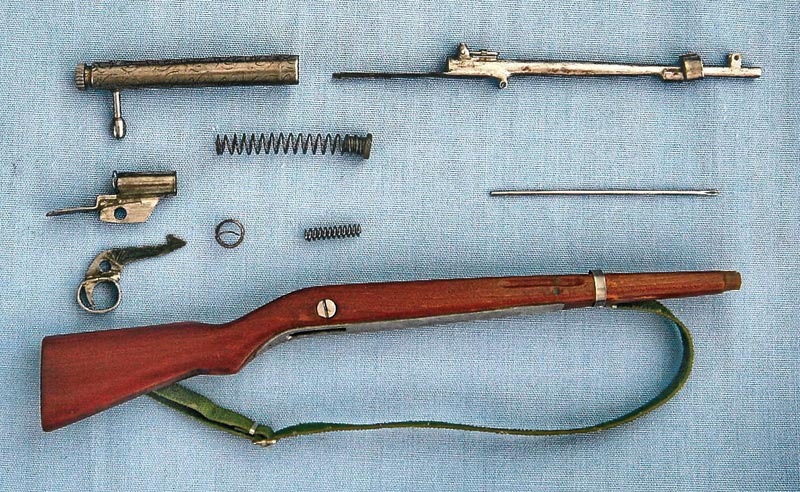
The miniature Type 38 carbine is disassembled to its component parts.
Not long after that, Xu Yan invented a small installation to enhance the shooting accuracy of the Type 56 Submachine Gun. This invention brought him an exciting chance to visit the weapon storehouse of Tianjin Guard Area, where he saw most of the real guns he had dreamed of, and studied their internal structures carefully. The experience in the plant not only allowed him to learn more about the gun mechanisms, but it also polished his skills in craftsmanship.
When Xu Yan became a mechanic in the vehicle department for the Tianjin Administration of Governmental Affairs, he found that a knowledge of electronics was needed. So, he managed to take advanced courses on electronics at the junior college of Nankai University, focusing on wireless skills.
During the four years (1986-1989), he had to go to classes after work, and sometimes brought along his little daughter who was born in 1982. It was definitely a difficult time for a husband and father, not to mention that he missed the training from high school. That period of time also developed his aspiration for learning.
Xu Yan has never stopped reading since then, and recently he published three articles in a major magazine in China—Small Arms. In his articles, Xu Yan not only introduces guns to amateurs, but also presents his understanding of miniature arms after decades of commitment in the field.
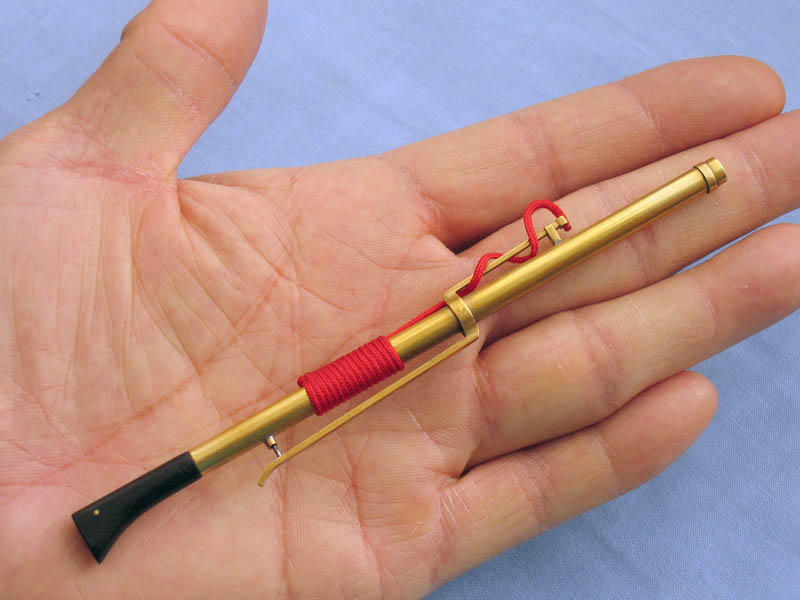
This 1/7 scale Italian Imperial Guard matchlock rifle was completed in 2002. It was made from brass, iron, and redwood.
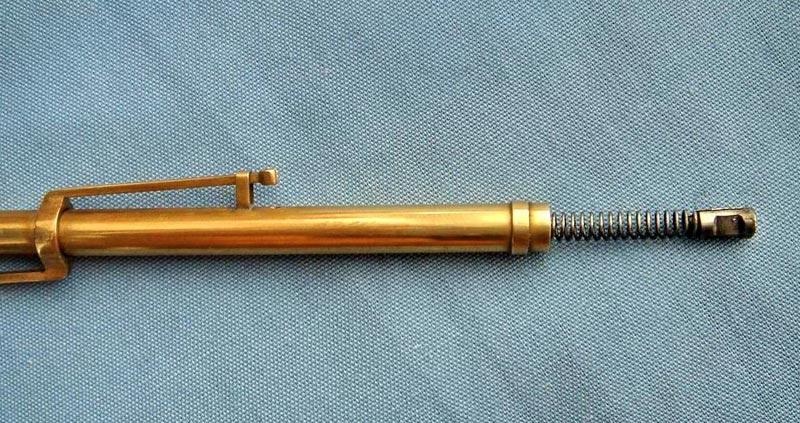
The miniature Italian Guard rifle is 129 mm long, and consists of 31 separate parts. The model has all of the functions of the original except it is spring loaded.
Admittedly, Xu Yan’s craftsmanship also comes from beyond the books and self training. He visited watchmakers, jewelers, locksmiths and lathe machinists who have excellent techniques for making miniature things. He is also assisted by his handy tools, which have to be remade many times for special uses. To Xu Yan, miniature gun making is more than a hobby. It is an art that can put together man’s skills and inspirations.
You cannot reach the peak within one day, but every thought and minute you pour in will be rewarded in your work. Xu Yan also spends some time enjoying classical music and making broadcast equipment. Right now, more miniature making plans are on his schedule. He believes that there is always room for improvement, and making things better is an inviting challenge for him.
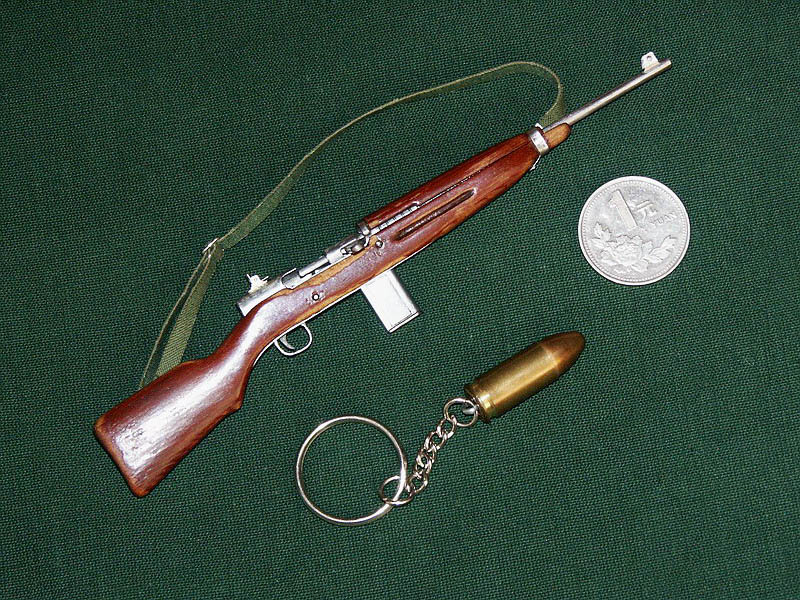
Made in 1965, this 1/6 scale M1 carbine is 152 mm long. A full-size bullet on the key ring underneath lends a sense of scale.
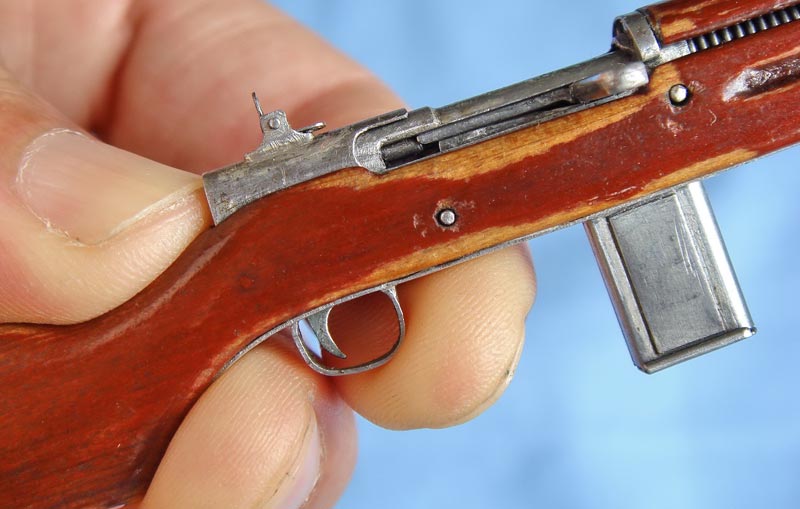
The miniature M1 carbine received an award at the first Zhong Hua Folk Art Treasures Exposition in 2001.
Xu Yan’s Miniature Gun Making Goals
Xu Yan’s first goal with his miniature arms making is to visualize the historical and cultural connotation.
He prefers to choose milestones in the history of mechanical guns as his models. They reflect the level of scientific and technological development, as well as the taste in art and decoration of the time. Special attention should be paid to the fact that recorded history of the development of wheel lock/matchlock firearms is lacking in China. Collection in this area is also rare. Thus Xu Yan’s works can help people remember and understand this period of history.
Xu Yan’s second goal is to exhibit characteristics of different guns.
The graceful figures and mystical charms of classical guns are often so delightful that one’s eyes can scarcely be taken off them. Moreover, almost every gun has its own history of design and application. Some famous guns even posses their own legends. Before putting one miniature into being, he will study the references to learn the origins of the actual gun, compare it with others of the same catalogue, and then try to grasp the characteristics of this one.
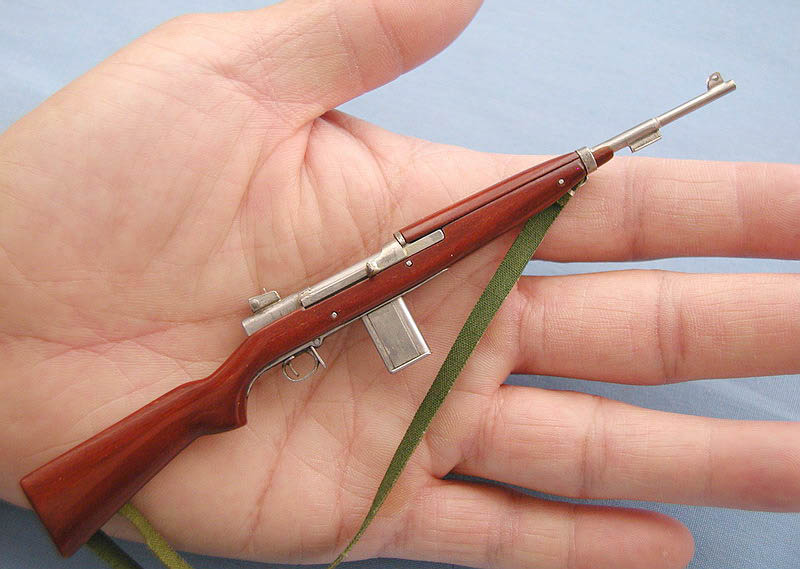
This 1/6 scale M2 carbine was built in 1966. The miniature rifle is 154 mm long.
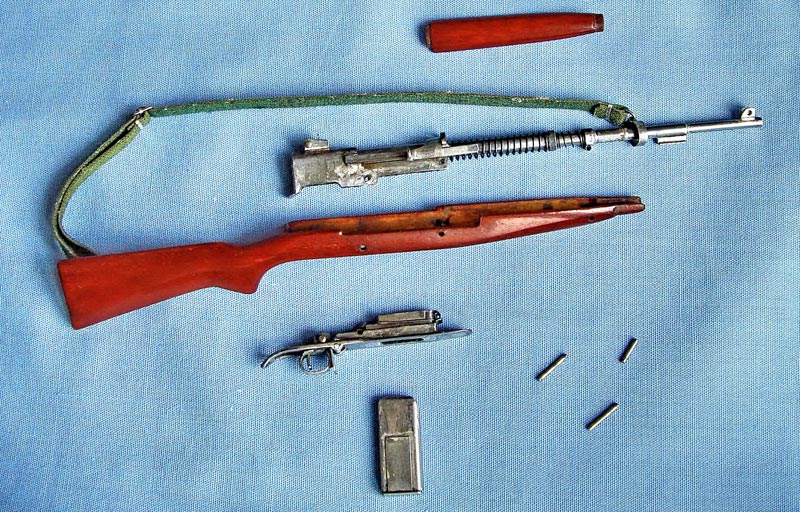
The disassembled parts for Xu Yan’s miniature M2 carbine.
Xu Yan’s third goal is to share the joy of creativity.
According to the laws in China, private possession of a gun in a scale of 1/2-1/1 copied from the real one is strictly prohibited. Relevant laws also stipulate that the power energy of bullets shot by toys/models should not exceed an average of 0.5 J. Hence the scale of his miniature guns ranges from 1/6 to 1/14. Xu Yan also uses rubber bullets, and makes sure that the shooting energy is smaller than 0.007 J. As a result, the internal structure must be redesigned, because of the limit of internal space and the force the miniature has to withstand when it shoots. It’s really a complicated project to do the redesign.
There are also challenges in the external operation mechanism. For example, after the trigger and the roll protector become a miniature, nobody’s finger can click from inside the trigger. So he combined the trigger and the roll protector to make a synchronous movement. By pulling back on the roll protector, one can fire the miniature. This creative combination balances the exactness in appearance and the smoothness of action.
Xu Yan hopes that his miniature guns can always surprise people with their creative qualities, and help them share the joy of creativity.
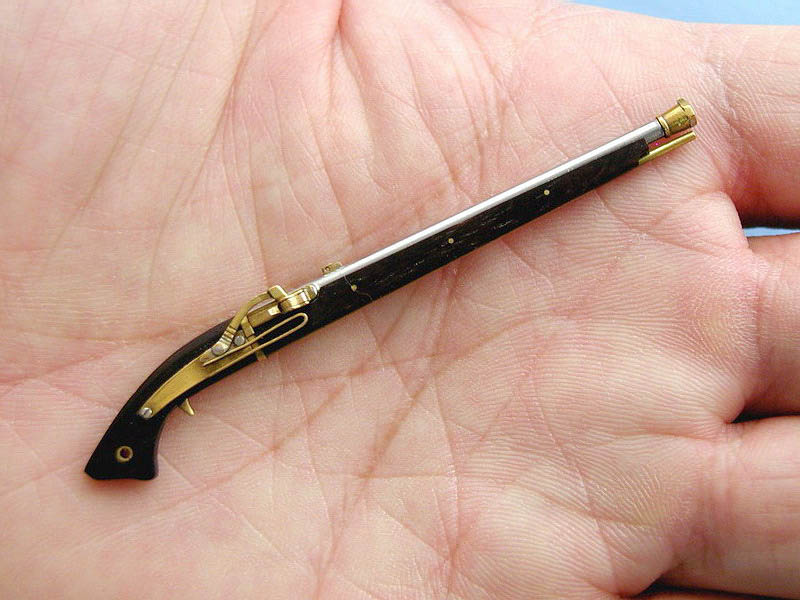
This tiny 1/14 scale Japanese matchlock pistol was completed in 2003. The original firearm is from the Jianghu period.
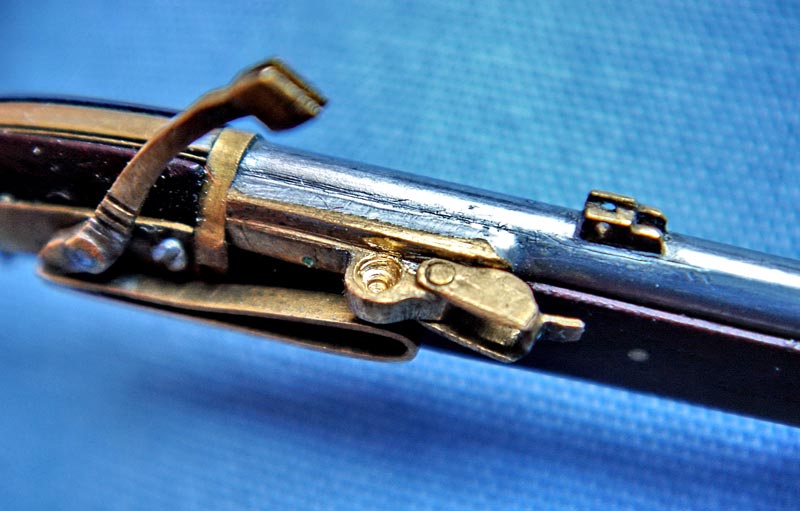
Despite its small size, the miniature matchlock pistol consists of 55 separate parts.
Xu Yan’s Workshop
Given our income and limited space, it is impossible for my father to have a separate workshop. His “workshop” is a reading desk in the corner of his bedroom, and sometimes the balcony of our apartment. He stores his various tools in the cabinets on both sides of his desk.
Generally speaking, his tools are simple. However, he also possesses a large number of miniature tools for accurate operations. Xu Yan also has several microscopes and other magnification devices for viewing small parts while working on them.
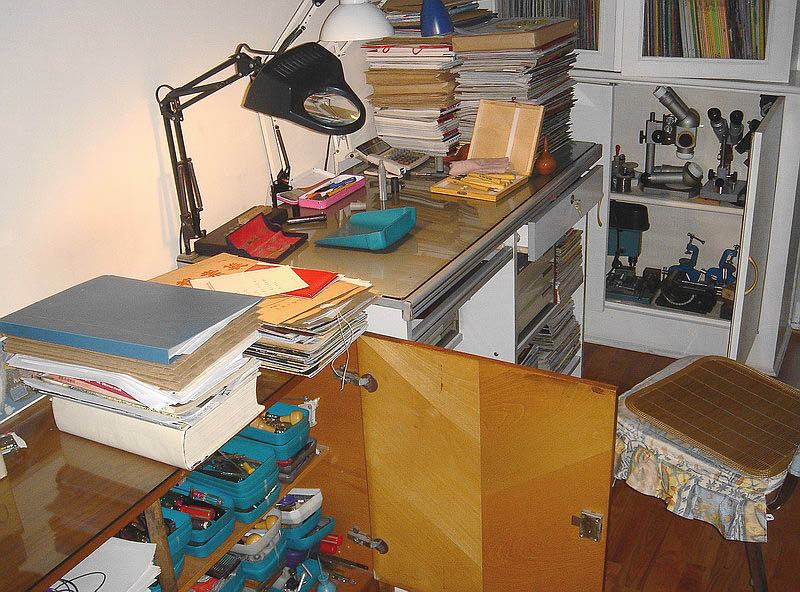
Xu Yan’s workshop is small, much like the weapons he crafts.
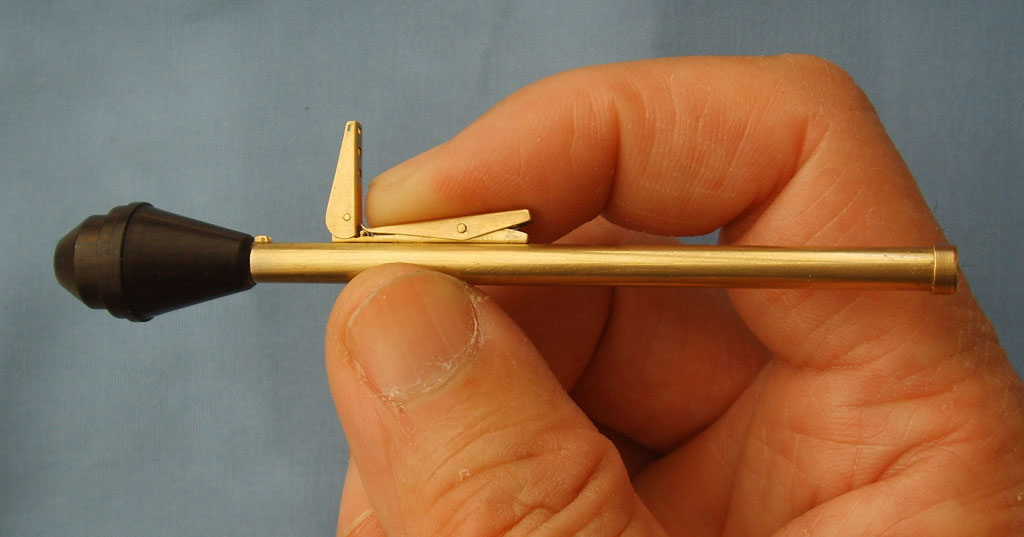
In April, 2009 Xu Yan sent us updated photos of a newer project—a 1/11 scale M-100 German Panzerfaust. This was an anti-tank rocket launcher used in WWII.
Philosophy Regarding Craftsmanship
If Xu Yan’s attitude toward his creation can be called philosophy, then his motto might be, “to be persistent, but not to be too concentrated.”
Indeed, you can never be too concentrated when you are working on a miniature. However, as a miniature arms maker, one needs much more than technology and time to realize his/her idea. My father doesn’t make miniatures every day. Actually, he enjoys pondering and reading, which broadens his vision and brings aspirations to him. He never rushes to finish his work because he spends a few months reading related materials, polishes his design, and then usually spends a lot of time experimenting.
Since there is little data on making certain miniatures, he has to design the experiments himself to get the needed data. To realize the drawing, it also takes quite a lot of time to find and test materials.
Even after his work has come into being, he hardly considers them completed. Adjustments are made everyday, along with the occasional polishing or remaking of accessories. Tests of the intensity and longevity of the works are also necessary. He leads discussions with friends who are experts in different fields. Xu Yan believes that solutions come into mind when the brain is prepared. One cannot reach the peak within one day, but every thought and minute one pours into it will be rewarded in the work.
After many years of making miniatures, my father spends more time on details and has become more critical of his projects—especially in the artsy quality that his pieces display. Xu Yan believes that the aesthetic dynamic movements and the accuracy of the work, as well as the effective shooting feeling in hand, are the top elements that define an outstanding miniature gun.
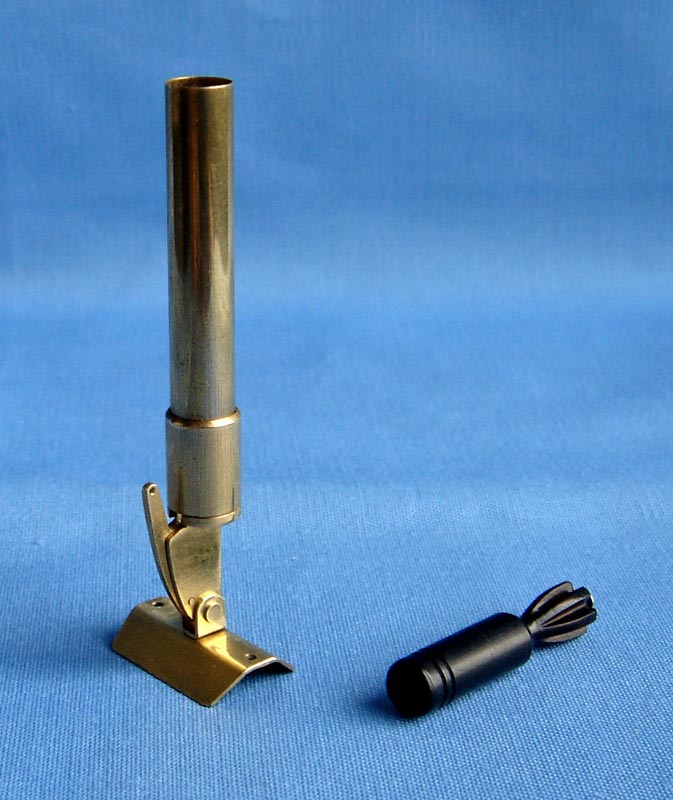
In October, 2009 Xu Yan sent photos of a new mortar he had just completed. It’s an English ML 51 mm mortar built at 1/9 scale.
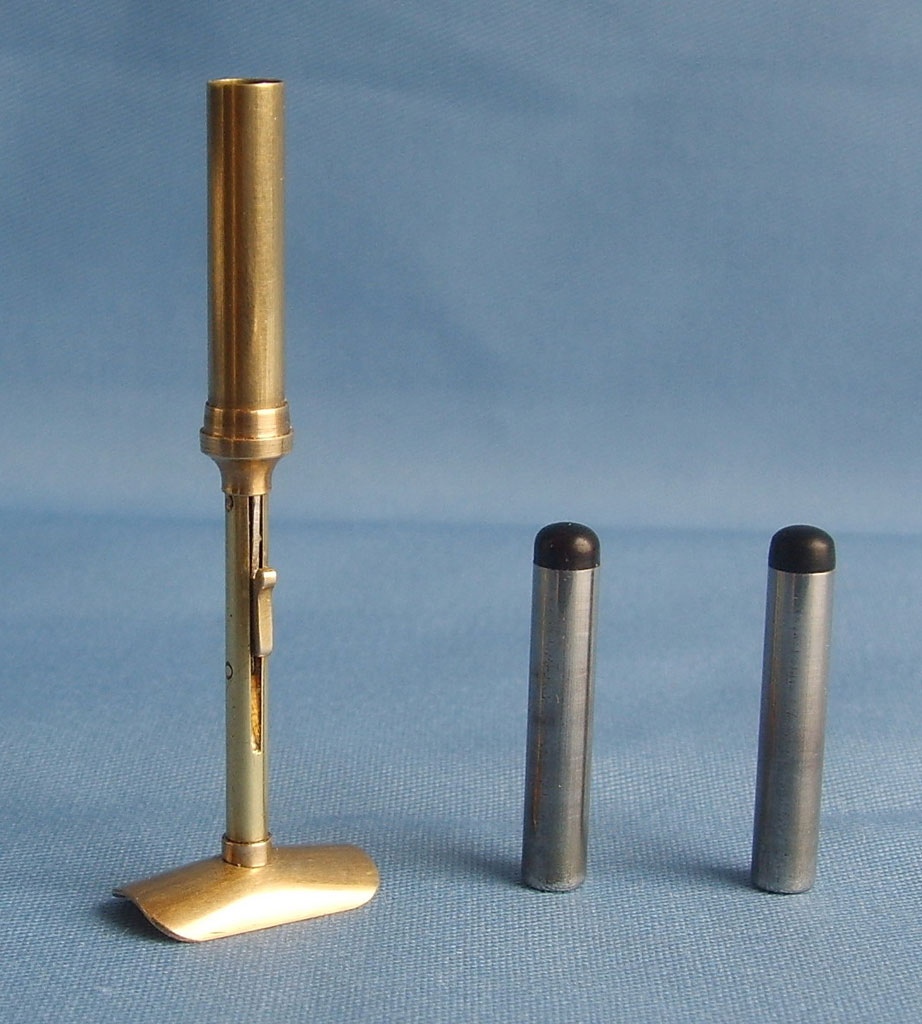
Another more recent miniature made by Xu Yan is this 1/12.5 scale Japanese Type 89 grenade launcher from WWII.
The Climate Around Craftsmanship and Individual Effort in Modern China
China is a nation that owns a spectacular history of culture, so there are a large number of folk artists or craftsmen who devote themselves to traditional forms of craftsmanship, such as kite making, carving, traditional tools, toy making, etc. Some of the technologies have been passed down for several generations.
There are societies for hobbyists of these “regular” creative activities which are either supported by the government or by the public. As for hobbyists whose interests are rare, they stay at the hobby level and make a living at their own occupations.
Speaking of my father’s persistence in miniature arms making, it’s fortunate that every time he was about to finish one miniature, he found the next archetype that he was going to make. Though he receives no assistance from the government or other professional organizations, Xu Yan has grasped a few chances to receive expertise. Most of the time, he has had to work on his own. Since the 1st Zhong Hua (China) Folk Art Treasures Exposition, his work began to be known by the public. More and more folk artists and craftsmen are introduced to the public by mass media, but still, there is no permanent place to showcase their work.
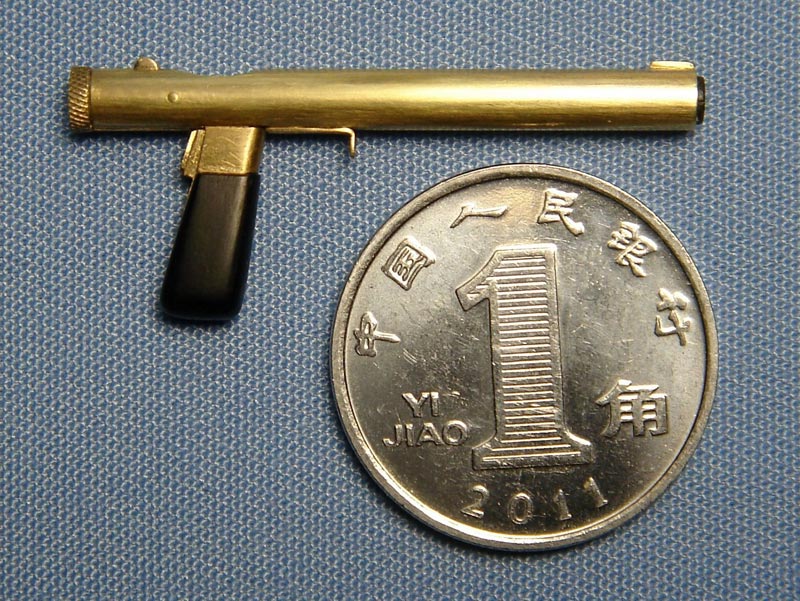
Xu Yan’s 1/10 scale British Welrod pistol. The miniature Welrod pistol is 31 mm long with a 2.5 mm diameter. It has a range of 2 meters, and consists of 26 separate parts which can be disassembled.
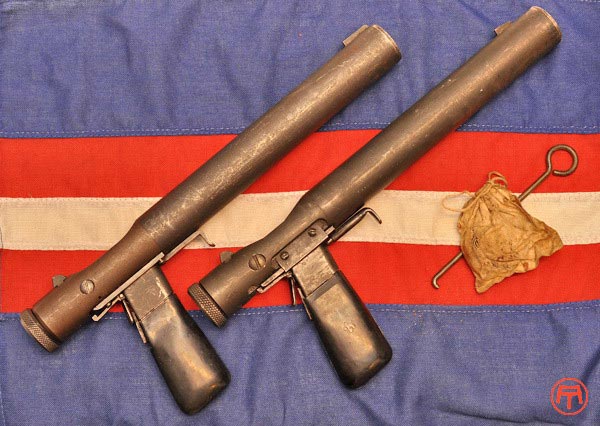
Mr. Xu actually made two of these 1/10 scale Welrod pistols. He duplicated the unique look of this weapon while also making it functional. The pistols fire a special solid round using a spring mechanism instead of gunpowder.
Details About Xu Yan’s Work
Xu Yan’s miniature guns are dynamic models that possess mechanical power. The exterior of his pieces exactly imitate existing guns that are historically famous. Therefore, the interior parts have to be carefully designed to make it possible for the miniatures to complete the shooting action smoothly. Xu Yan draws scripts himself, and makes every accessory of the miniatures by hand. He is assisted by special tools that are hard to find, or even made by himself. All the materials he uses are brass, mahogany and galvanized iron.
The goal of Xu Yan’s creative activity is to exhibit the development of gun mechanics, and to show the excellence of craftsmanship throughout history as demonstrated through these products.
As of 2016, Xu Yan’s work could essentially be divided into eight periods based on their distinct interior structures.
The first period of Xu Yan’s work, in 1962, consisted of static miniatures. These were more basic early miniatures that do not function. The second period of work dates to 1963, when Xu Yan made his 1/6 scale Mauser 98K rifle.
In 1964, the third period of his work involved making a 1/6 scale Type 38 carbine. The miniature carbine is 151 mm in length.
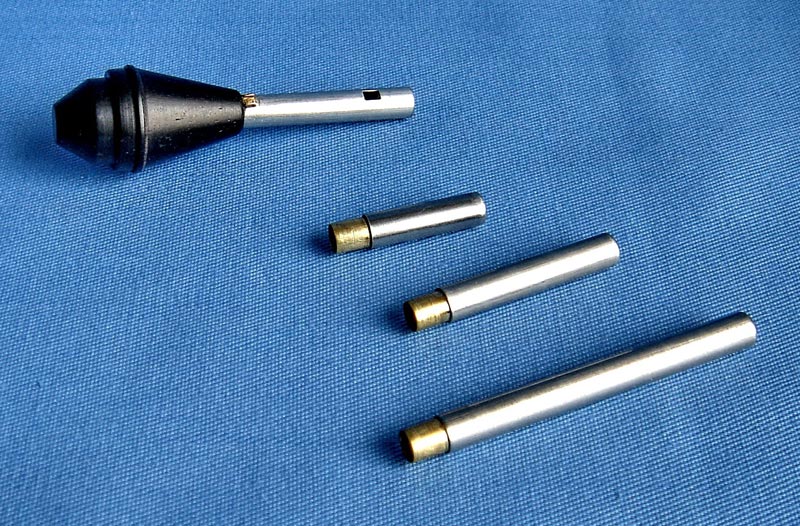
Like several of his other spring-loaded models, the Panzerfaust actually fires a replica of the rocket. The range of the miniature is from 1.2 to 4.8 meters for armor piercing ammunition, and 2.4 to 6 meters for grenades. Range was determined by the length of the “tail” of the projectile.
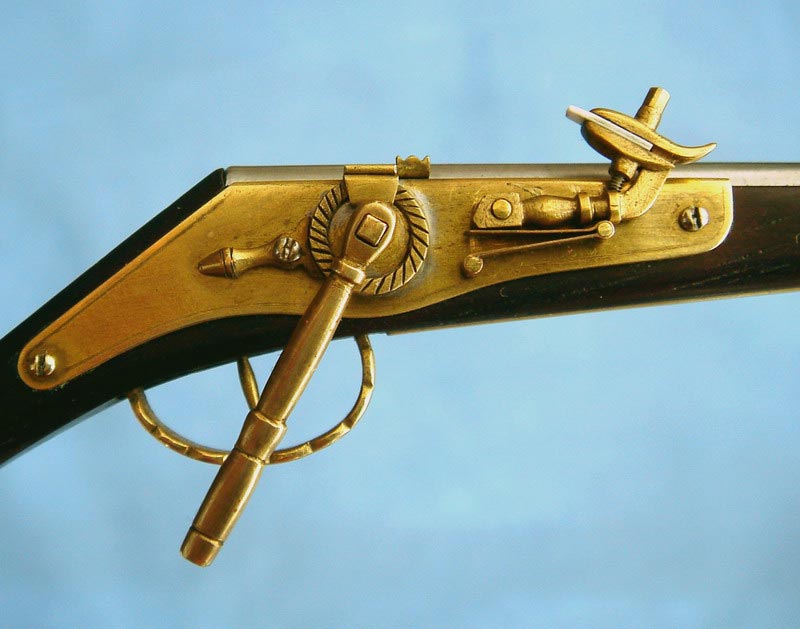
A close-up view of the 1/6 scale British wheel lock pistol.
Xu Yan’s fourth period of work occurred in 1965 when he made a 1/6 scale M1 carbine. The carbine is 152 mm long, and was made from iron and wood. Within a range of 1 meter, the carbine can hit a target of 10.1 mm. The whole gun consists of 46 separate parts. It can be dissassembled and put back together, and the carbine is able to fulfill five actions. This miniature received an award in the first Zhong Hua Folk Art Treasures Exposition in 2001.
In 1966, the fifth period of work included an M2 carbine built at 1/6 scale. The carbine is 154 mm in length.
The sixth period of work spans from 1992 to 2003. During this time, Xu Yan made a 1/6 scale 16th century British wheel lock pistol which is 88 mm long.
Within a range of 2 meters, the wheel lock pistol can hit a target of 20.2 mm. The whole gun consists of 56 separate parts, and can be dissassembled and reassembled. The wheel lock pistol can fulfill eight actions, and was made from brass, iron, and redwood.
This pistol is notable because the wheel lock employs mechanics to set up firing, which initiated the age of mechanical firing after the age of rope fire devices. In 2004, this miniature earned awards in the China International Folk Art Treasures Exposition as well as the Zhong Hua Folk Art Treasures Exposition.
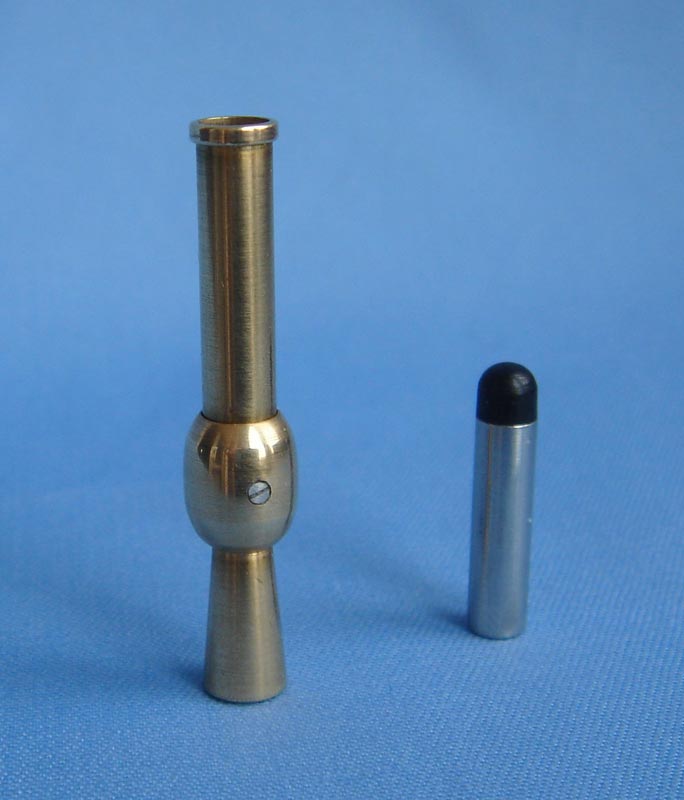
Xu Yan’s miniature copper spring pocket gun has 16 component parts which can be disassembled. The miniature is based on an ancient Chengzihe copper gun from the Yuan Dynasty. While the original gun was ignition fired, the miniature is a spring hand gun. As such, certain parts needed to be skillfully converted into a trigger, which was the biggest challenge.
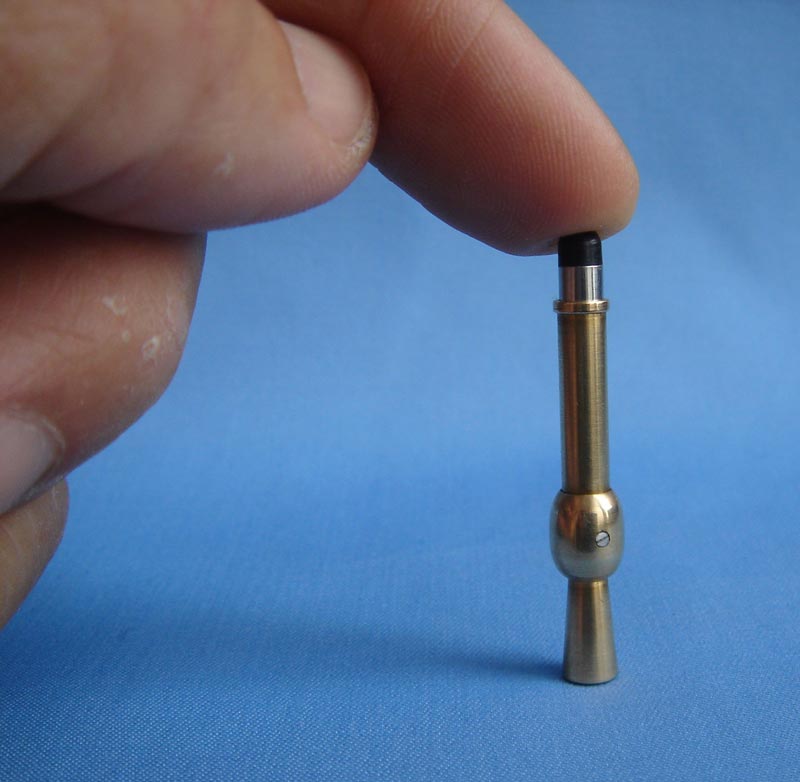
This photo shows the loading of the “bomb” by compressing the internal spring before firing. A sear on the inner edge of the bottom hook engages the projectile when it’s fully cocked.
Xu Yan’s seventh period of work spanned from 1996 to 2003, with his building of a 1/7 scale Italian Imperial Guard’s matchlock rifle. The rifle is 129 mm long, and was made from brass, iron, and redwood. Within a range of 3 meters, it can hit a target of 20.2 mm. The whole gun consists of 31 separate parts, and can be dissassembled and reassembled.
The miniature rifle can also fulfill three actions. This firearm is historic because it was the first time that a straight tube was used for the structure of the gun’s body. The rifle is made with an assembly of four layers and ten sections. The matchlock rifle enabled someone to both hold and fire the rifle, rather than having another person apply the match to the gunpowder like a cannon. This enabled the shooter to complete the most difficult firing tasks at the same time, thus improving the degree of accuracy for the shot.
The eighth period of Xu Yan’s work spanned from 1998 to 2003, when he built a 1/14 scale Japanese matchlock of the Jianghu Period. Within a range of two meters, the 72 mm-long firearm can hit a target of 10.1 mm. The entire weapon consists of 55 separate components, and can also be dissassembled and reassembled.
The miniature matchlock can fulfill six actions. These actions include: (1) Using the barrel to push the bullet into the gun thorax. (2) Withholding the trigger can launch fire. (3) The matchlock collet can hold the fire rope. (4) The cover of the gunpowder pond can rotate and separate the combination. (5) Pressing the head of fire rope can lift and hang up the trigger. (6) The cleaning rod can be inserted and drawn out.
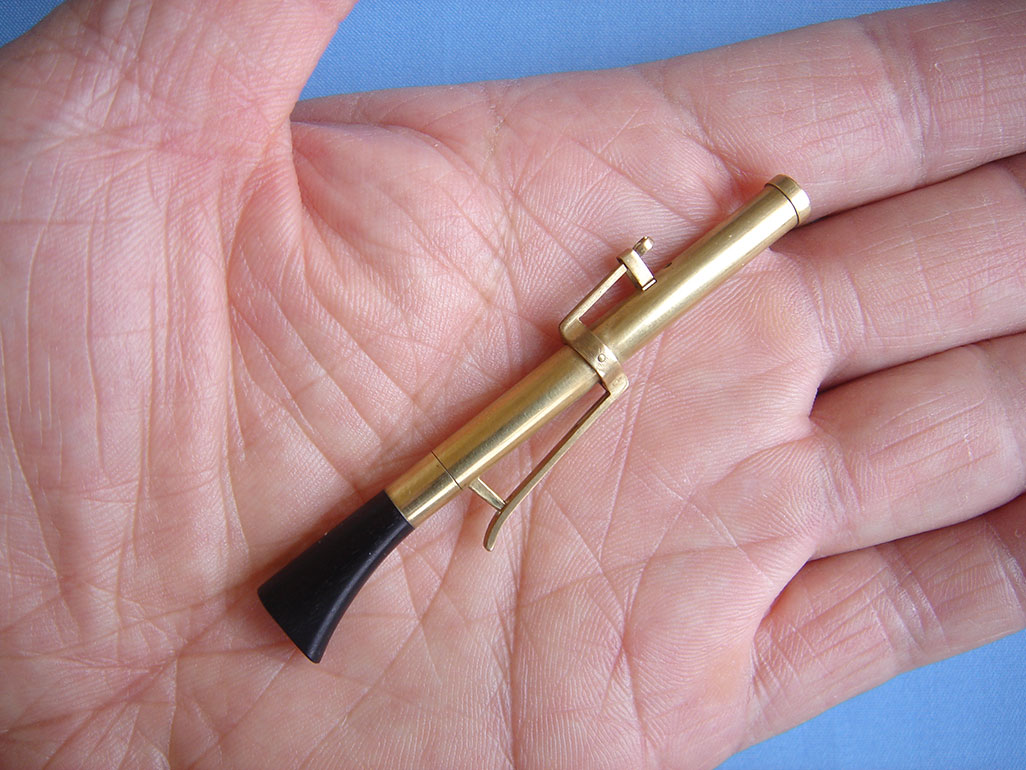
In June, 2014, Mr. Xu sent this photo showing modifications that he made to his 1/7 scale Italian matchlock rifle. The updated firearm is now considerably shorter.
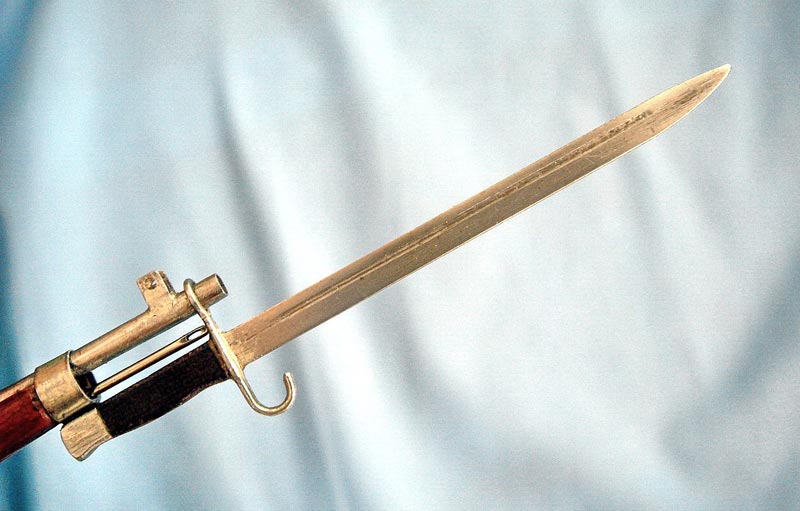
The 1/6 scale Type 38 carbine also features a detailed bayonet that can be attached to the end of the barrel.
The matchlock is notable because it was the first use of a hammer beat structure. It also has fire discharge devices. The action on this firearm needs to be perfectly coordinated. Given that the scale would be 1/14, the design and construction required extremely delicate technique. This fire rope gun adopted the pressure fire lighting method. The cover of the gunpowder pond, the winding assurance device, and the aim tools made this an outstanding matchlock for the time period.
In summary, Xu Yan’s miniatures replicate famous guns that are milestones in the history of mechanical firearms. The scale ranges from 1/6 to 1/14. He uses rubber bullets and spring power to make sure the shooting energy is smaller than 0.007 J. Mr. Xu’s creative redesign of the internal structures sets a balance between exactness in appearance and the smoothness of shooting action.
—Shelley Xu
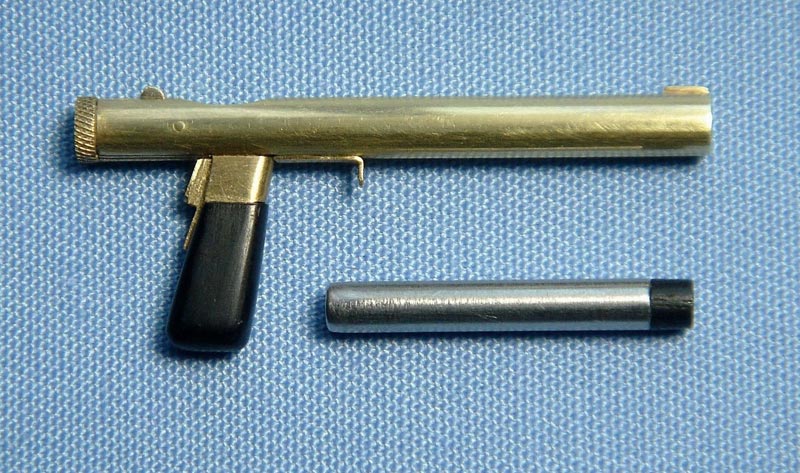
Essentially, what would be the silencer tube on the full-size Welrod pistol became the projectile on Xu Yan’ miniature. The projectile/silencer is detached here. The pistol is so small that holding it while firing requires a special technique.
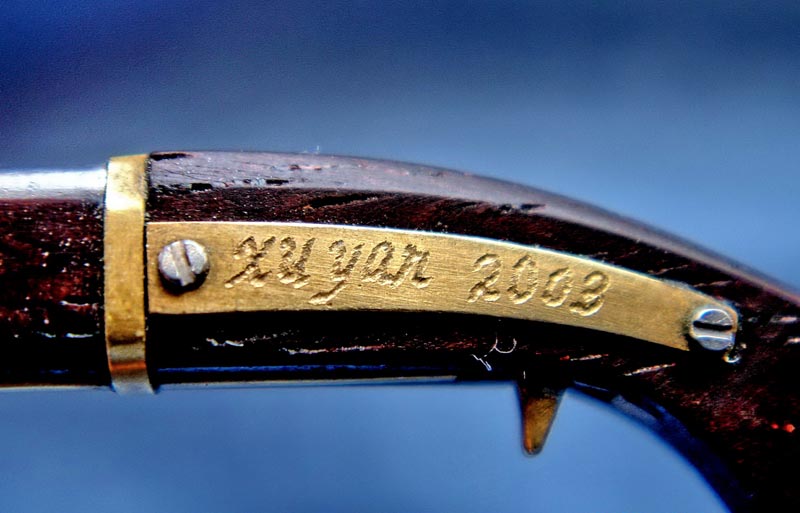
Xu Yan’s signature is engraved on the side of his 1/14 scale Japanese matchlock pistol.
More About Xu Yan
Shelley Xu also sent along more details about Xu Yan’s personal life, accolades, and media features on his work. He received his education in electronics from the Junior College of Nankai University, Tianjin, China (1986-1989). As a working professional, Xu Yan worked in equipment maintenance at a compound chemical plant from 1971 to 1982.
From 1982 to the present, he has worked as a mechanic and dispatcher for the vehicle department with the Tianjin Administration of Governmental Affairs. Xu Yan is also a member of the Tianjin Folk Artists Society. Along with making his miniatures, Xu Yan has also written a handful of articles for publication.
His article, “A Classic of Italia Match Lock,” was published in Small Arms magazine Vol.13, 2005. Another piece entitled, “Unscramble the History of Japanese Match Lock,” appeared in Small Arms Vol.20, 2005. A third article, “Wheel Lock Pistol—Pre-existence of Flint Lock Pistol,” was published in Small Arms Vol.5, 2006.
Additionally, an article from the Miniature Arms Newsletter, October, 2006 highlights craftsmanship awards for Xu Yan, Michel Lefaivre, and David Kucer. That article also shows some examples of Mr. Xu’s work.
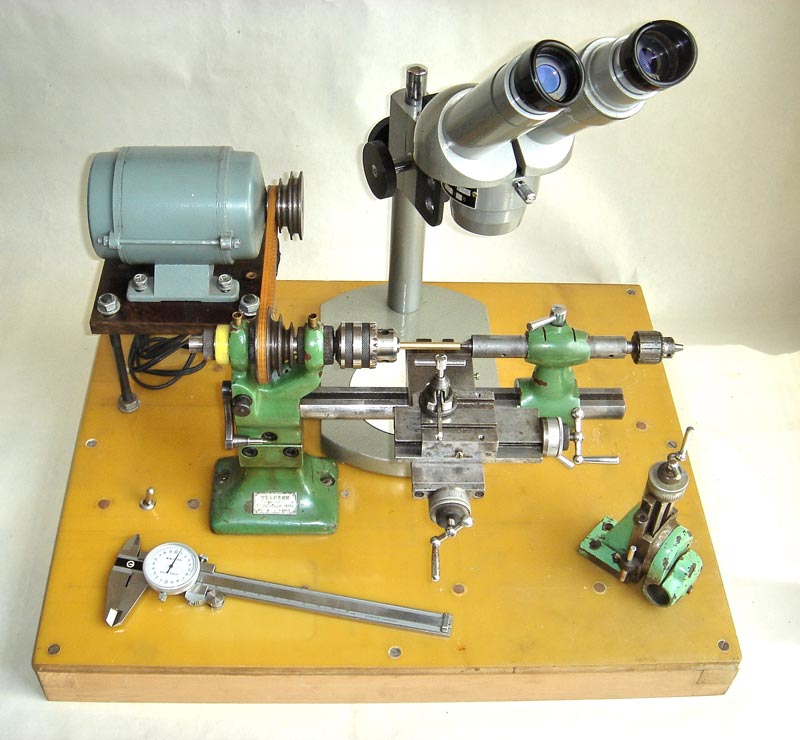
Xu Yan’s lathe is a D-bed jeweler’s type lathe with a small stereo microscope that he added for tiny work. The reversible tailstock has a drill chuck on one end and a dead center at the other.
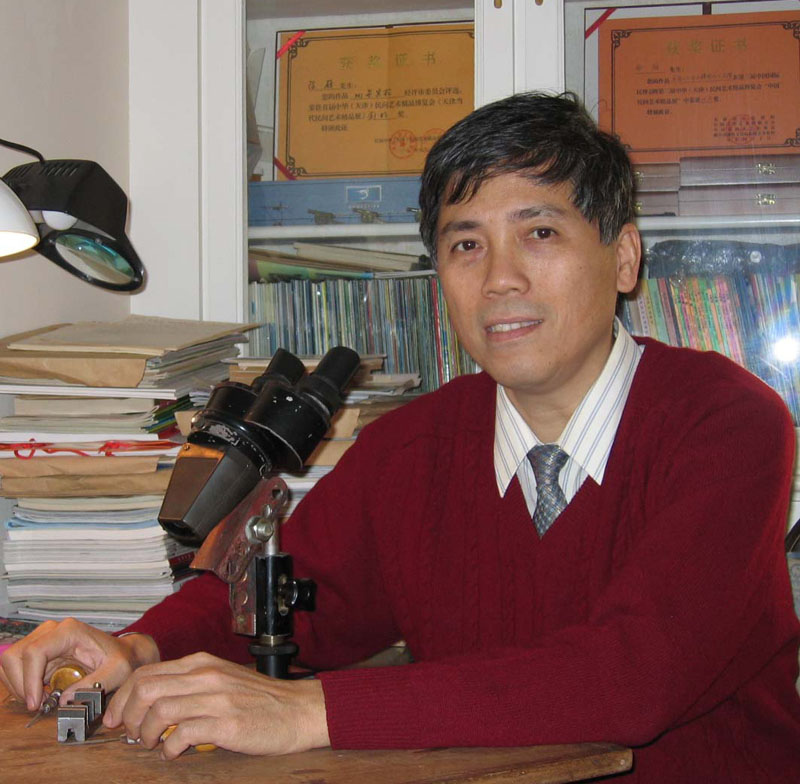
Xu Yan sits in his small but productive workspace.
Additionally, Xu Yan has also taken part in some interviews, videos, and other reports. He was interviewed by Small Arms magazine, The People’s Liberation Army Life, JinWanBao (evening newspaper of Tianjin), and Cheng Shi Kuai Bao (brief news of Tianjin city).
Mr. Xu’s work also appeared in the following reports: “Top Miniature Gun of Zhonghua (China),” Famous Guns, Vol.4, 2005. ““The 1st Master of Miniature Guns in Zhonghua (China),” Dragon Gate, Vol. 3, 2004. “40 Years’ Longing for Miniature Arms,” ShenYang Daily, 01/2003. “Glory of Miniature Guns,” Album of Military History (a magazine published by China People’s Revolutionary and Military Affairs Museum), 08/2002. “Polish the Top Miniature Arms of China,” Hidden Dragons and Tigers, The People’s Liberation Army Daily, 08/2002.
Two articles featuring Xu Yan’s work are available in PDF format, however they have not been translated into English. For anyone interested, here is the Chinese version of an interview and report by Small Arms titled, “Passion and support of small arms among the public.” The other Chinese article, written by Xu Yan himself, is titled, “Pre-existence of flint lock pistol.”
Along with these publications, Mr. Xu was also featured in a few videos. Tianjin TV showed his work in a 2003 video entitled, “A Man Falls in Love With Miniature Guns.” In 2006, the e-news branch of Tianjin TV ran another video about Xu Yan called, “Tremendous Commitment in Miniature Arms.” Mr. Xu was also featured in a video titled, “Folk Olympic,” by Channel V of Tianjin TV.
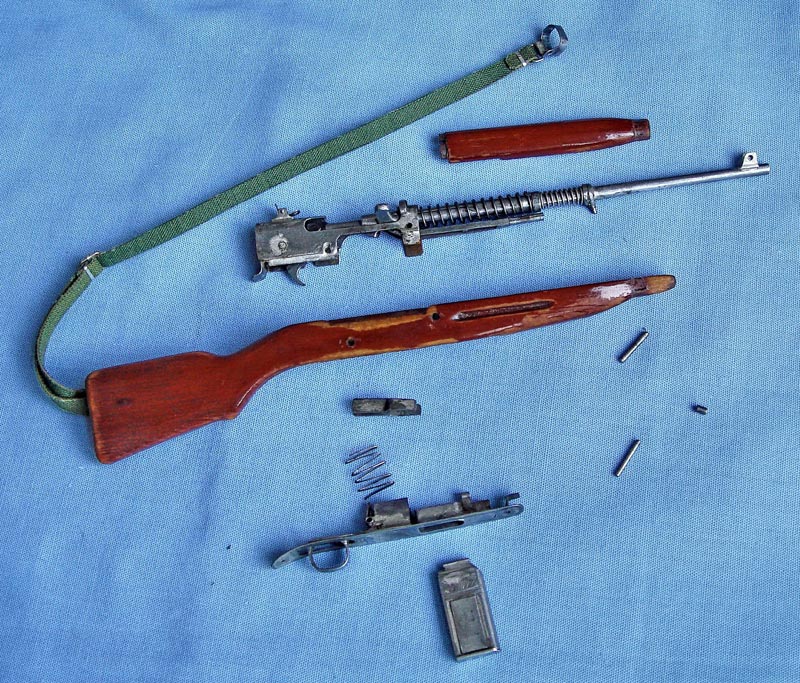
Various components of the disassembled 1/6 scale M1 carbine.
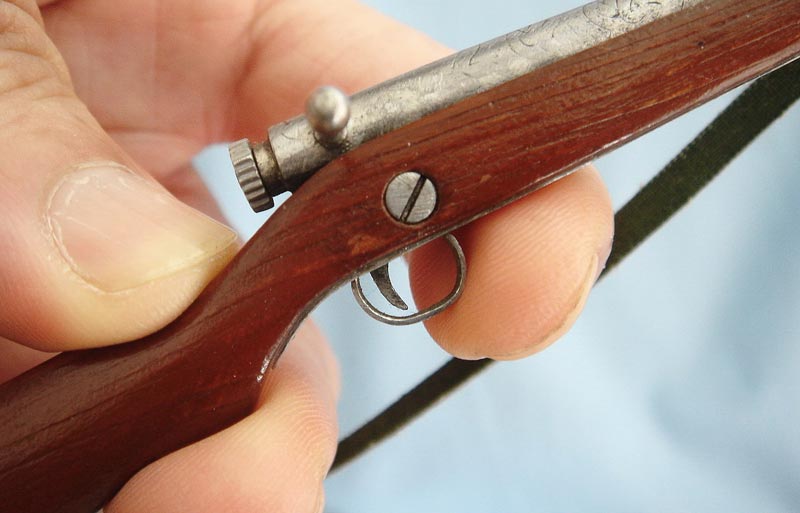
A close-up of Mr. Xu’s 1/6 scale Type 38 carbine.
View more photos of Xu Yan’s impressive collection of miniature firearms.